Exam process

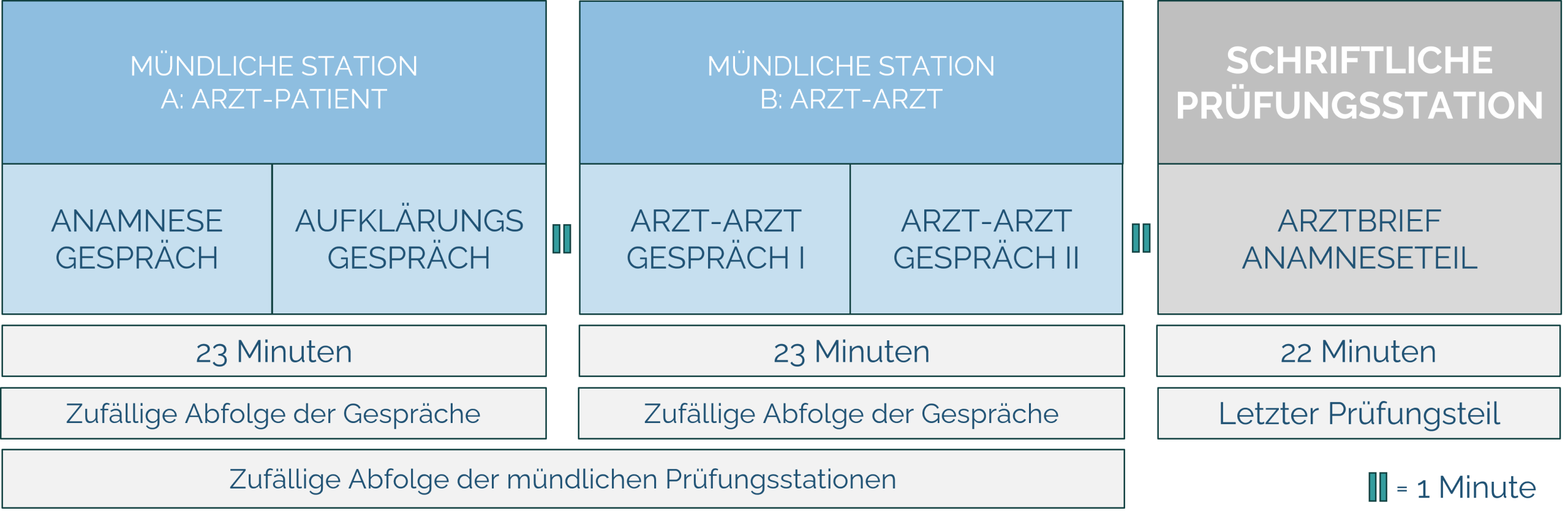
The examination format for recognition in Bavaria and Rhineland-Palatinate consists of a total of two oral examination stations and one written examination station. The order of the oral stations may vary. The examination always concludes with the written station. You will have a one-minute break between stations.

Apart from the examination situations mentioned above, there are no further examination components. For example, a vocabulary test or the translation of technical terms is not part of the examination.

To reflect professional practice as authentically as possible, the OSCE (Objective Structured Clinical Examination) format was chosen for FaMed. The cases covered differ both within and between the examination stations. All examination content is drawn from the subjects of General Medicine, Internal Medicine, or Surgery.

Details

The order of the oral stations may vary. The exam always concludes with the written station. You will have 11 minutes for each of the oral stations, and 22 minutes for the written one. You will have a one-minute break between stations.

Organigram zum Ablauf von Sprachprüfungen

Oral exam stations

Doctor-Patient Communication (23 minutes including reading time)

The medical-patient communication examination station includes a medical history interview and an informed consent interview, where the cases do not have to relate to each other. In this examination station, it is particularly important to use plain language and to formulate all statements clearly and comprehensibly, so that misunderstandings can be avoided.

Anamnesis interview

The exam candidate should elicit the information necessary for a medical history from the patient within the framework of an anamnesis interview, allow them space to report their complaints, and create a respectful conversational atmosphere.

Pre-operative consultation


The candidate should explain the procedure of an upcoming operation, the risks of the intervention, and perioperative management measures to the patient. The focus here is on the use of lay language (everyday expressions instead of medical jargon), and ensuring that the patient has understood all the information. as well as expressing empathy for concerns and questions. Important: Prior to the information and consent discussion, all information that can be used to conduct the information and consent discussion will be displayed. No specialist knowledge will be tested.

Doctor-to-doctor communication (23 minutes including reading time)

The doctor-to-doctor communication examination station consists of two patient presentations. When communicating between doctors, care must be taken to use appropriate professional language and to express yourself as concisely and succinctly as possible. Linguistic errors that could lead to misunderstandings and, consequently, treatment errors must be strictly avoided.

Patient introductions


In the patient introductions should the candidate communicating with colleagues using specialist terminology and idioms (here: Chief Physicianto prove.

As well as the dissemination of information Replies to Follow-up questions The requirements should be formulated concisely and precisely. Important: All information that can be used to perform patient simulations must be included. No specialist knowledge will be tested. 

Written examination station

(22 minutes including video time) 

Based on a short video, which can also be paused, the candidate will write the patient history section of a medical report.

History section of a doctor's letter

When drafting the doctor's letter, care must be taken to ensure that all patient information appearing in the video is correctly phrased according to medical terminology standards.

These include:

  • Name, perhaps age, weight, height
  • Current complaints
  • Pre-existing conditions and medications
  • Nicotine and alcohol consumption
  • Family and social history
  • Possible travel history


The doctor's letter should be written in full sentences. When quoting patient statements, the subjunctive (Konjunktiv I) should be used where appropriate.